Examples of Protagonists
These Portraits show less a "correct character-sheet format" than different ways of bringing someone into view in Glorantha.
They are not mandatory templates. Their organization varies because the same things do not matter in the same way to everyone.
Hanya of Jillaro
“We must help the Goddess and preserve civilization.”
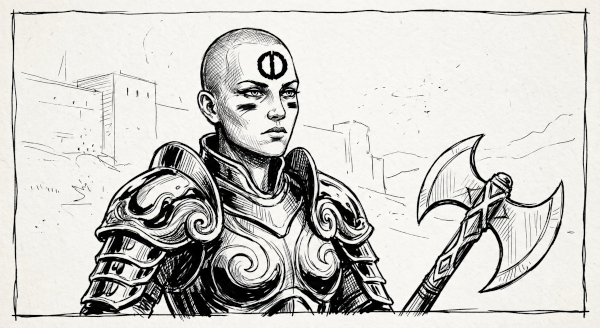
Woman, 27 — Lunar Theist from Sylila.
Hanya is a Guardian of Jillaro, a warrior devoted to Hwarin Dalthippa. She serves with a double-edged axe, a bow, mercury armour that does not sink, and a thoroughbred horse.
Yet her Portrait turns on a contradiction more important than her equipment: she is wholly committed to the cause of the Red Goddess without bearing the Moon Rune.
Runes
 Fire — discipline, intransigence, haughtiness toward barbarians.
 Harmony — calming tensions, self-restraint, horsemanship.
 Movement — speed, cleaving axe blow, urgency: the Empire is in danger.
Guardian of Jillaro
- great-axe combat;
- forced march;
- going without sleep;
- tactics, archery, horsemanship;
- aesthete, war paint, head shaved in Lunar fashion;
- virtues: honour, sacrifice, unwavering faith, beauty, Sylila first;
- relationships: the Fort of the Conquering Sister, several Silver Shields.
Novice of Hwarin Dalthippa
Her magic is subject to the Lunar cycle.
Hanya has particularly retained from the goddess:
- Safe Route;
- See the Long Term;
- Intimidate Barbarians;
- Feel the Enemy's Weakness;
- Cleaving Axe Blow;
- Red Mask of Terror.
Mythic teaching — the Daughter's Road Campaign
Among Hwarin's gestures that her teaching gives Hanya to contemplate, the Daughter's Road Campaign has an obvious place.
After years of preparation, Hwarin chooses a line of Power through the southern lands and resolves to follow it to her goal. She leaves Jillaro, crosses the bridge where her husband and son lie, mounts a war steed, puts on a red mask, and marks the road with her steps. At Mirin's Cross, a battle of magic brings forth the New Fire of the Lunar Way: across the waters of the Black Eel there remains a crystal bridge, a lasting passage for the army that follows her.
For Hanya, this story connects things that a conventional character sheet would easily separate: preparing a road, seeing the long-term plan, building, terrifying resistance, and turning conquest into lasting order. Safe Route, See the Long Term, and Red Mask of Terror are therefore not merely juxtaposed abilities: they are ways for her to understand and extend some of Hwarin's gestures.
Hanya has not, however, received the whole goddess. She is still a novice: her teaching opens certain magical knowledge and ways of acting to her without making her a fully initiated participant in all Lunar mysteries.
Hanya understands Hwarin Dalthippa mainly through conquest and the ability to see plans unfolding. For her, the Red Moon is more a power of civilization, fear, and coercion than an inclusive mystery.
She tried to integrate the Moon Rune and even had it tattooed on her forehead. But she is not yet ready to be fully initiated into the Lunar Way.
What this Portrait shows
Hanya is not "a Lunar warrior" accompanied by a list of abilities. Her religion, Runes, and personality do not overlap perfectly.
Her magic itself cannot be separated from how she understands Hwarin: it comes from a teaching, a relationship that is still incomplete, and a set of divine gestures she is learning to recognize.
That gap is precisely what makes her interesting to play.
Peek-ee-peek
“The prophecy is coming true and our tribe was chosen long ago to be the protectors of the Moon.”
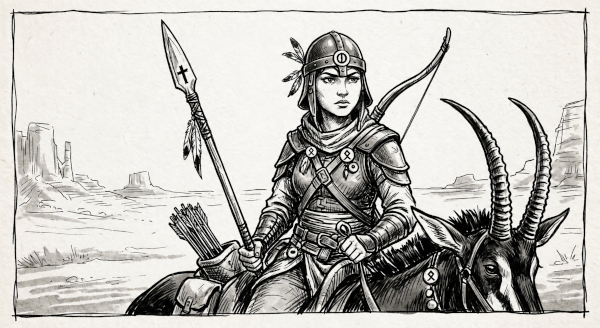
Woman, 22 rains — Praxian Animist, daughter of a Khan.
Peek-ee-peek is a Sand Nomad scout. She carries a bow, lance, helmet, and fetishes, but the most important presence beside her is Fta-Ah, her sable antelope.
Runes
 Moon — sense of superiority, curiosity, prophetic conviction.
 Death — sure arrow, sharp opinions, impulsiveness.
 Spirits — sensitivity to the unseen world, seeing and feeling spirits, bargaining with them.
Sand Nomad
- be one with her antelope;
- despise horses and sedentary people;
- survive in the Wastes;
- navigate;
- know the customs, myths, and geography of Prax;
- read Praxian knots;
- relationships: her tribe, her father Paak-the-Cunning;
- virtues: pride, freedom.
Tradition of Waha the Butcher
- virtues: eliminate Chaos, soothe the soul of a slain animal, feed, defend, and warn the tribe;
- miracle: Death Lance.
Peek carries several fetishes. Each gives her a power but also imposes a way of living:
- Kill the Stranger — do not kill for one moon afterwards;
- Know the Lineage — sacrifice to the ancestors at every full moon;
- Beast Above Man — be vegetarian;
- Water-Seeking Spirit — drink nothing but water;
- Pacification of Spirits — never defile a place inhabited by a spirit.
Tradition story — Waha's Tasks
In the Darkness, Waha appears in a ravaged world where the survivors are scattered and dying. He gathers them and teaches them new ways to live. He frees Eiritha's Protectresses so the herds may return, teaches how Death can serve life, fights or tames dangerous powers, and cleanses the Wastelands of the Devil's presence. His Tasks eventually bind together again the peoples, spirits, and different parts of Prax.
This story explains why Peek's Tradition does not easily separate survival, Death, struggle against Chaos, protection of the herd, and duty to the tribe.
But Peek is an animist: she does not turn this story into a list of miracles to reproduce. Her magic passes through the concrete relationships with spirits she carries in her fetishes. Waha's Tasks teach her which relationships matter and what world those spirits help maintain; the taboos say what those relationships require of her.
Fta-Ah
Sable antelope — courageous, fast, faithful.
Fta-Ah is not filed under "equipment": the relationship deserves its own Life Chapter.
What this Portrait shows
For Peek, the character's powers cannot be separated from her relationships, obligations, and way of inhabiting Prax.
A fetish is not merely something she owns. It asks something of her in return. A tradition story is no more a list of powers: it gives meaning to the relationships that make her magic possible.
Talimar, called Tal
“Things are. Even when contrary, they are there, together.”
Man, 20 — Sartarite of the Grey Heron clan, young initiate of Lhankor Mhy.
Tal shows two properties of the Living Portrait: it can transform because the Protagonist comes to understand what they lived differently, then accumulate the Traces left by later Situations.
 Air — the middle
Tal recognizes himself in the space between things: earth and sky, high and low, clouds, wind, Moon and stars. Far from his clan, Air has also become the tangible reminder of his roots.
 Law — what binds
Tal first called Harmony his intuition that different, even contrary things could belong to the same Cosmos.
During his initiation, he understands this experience differently: for him, it was more deeply Law, what binds without erasing differences.
At Jonstown, this understanding gains a new limit: Law does not ask the Sage to make the world neater than it is.
 Truth — what sets him in motion
Tal first called Movement his curiosity and desire to go elsewhere.
His initiation reveals a direction: that movement was seeking Truth. Not certainty possessed, but what compels him to keep searching.
His first investigation as a Grey Sage further clarifies this relationship: seeking Truth does not mean manufacturing certainty when it is not available.
Young Grey Sage
Tal begins to put into practice what he learned from Hendrik, son of Enderos.
- insatiable curiosity;
- distinguishes what he knows from what he thinks he knows;
- sustains several hypotheses without prematurely turning one into a truth;
- learns to formulate precisely what is established and what is not;
- tablet of the seven differences given by Hendrik;
- ancestral knife given by his father.
At Jonstown, this Life Chapter changes in scope. Tal had mainly imagined the Grey Sage through myths, texts, knowledge, and travel. His first investigation reveals another dimension of his vocation: the community also comes looking for a Sage when testimony must be gathered, facts compared, Law illuminated, and what is known formulated precisely enough for other people to act afterwards.
For Tal, knowledge thus becomes not only a quest but a responsibility toward those who will have to live with what he says.
Grey Heron and the roads of Tarsh
Tal is the son of Calimar and Urestona, carls of the Grey Heron clan, of the Colymar tribe.
His uncle Grimar, a merchant, took him to Tarsh when he was young. Tal discovered a Lunar civilization there that he admires in some respects and rejects in others. This contradiction remains one of the deep tensions that set him in motion.
Among the people and belonging that matter:
- Calimar and Urestona, his parents;
- Grimar, his merchant uncle;
- Hendrik, his teacher;
- the Grey Heron clan;
- the clan's old traditionalist Grey Sage.
Myth of Lhankor Mhy — the quest for knowledge
Hendrik told Tal the myth of Lhankor Mhy, born of Orenoar, Mistress of Truth, upon Mostal, the Mountain of Law. The traditions themselves do not all agree on his father. When knowledge is lost in the Darkness and Elasa disappears, Lhankor Mhy invents writing to preserve what has been learned, then continues his quest with the Lightbringers.
Hendrik stresses one point that marks Tal: even Lhankor Mhy, who embraces all knowledge, sometimes succeeds and sometimes fails. Yet he continues to seek.
Tal retains five gestures from the myth:
- distinguish what is true;
- remember what has been learned;
- preserve knowledge through writing;
- seek what is missing;
- continue searching even when one already knows.
Before his initiation, Tal already knew this myth, meditated on it, and had begun to recognize his own way of acting within it. Initiation changes the nature of that knowledge: he is no longer merely someone who understands a story about Lhankor Mhy; he is connected to the God.
These five formulations are therefore not five spells. They are five gestures of the God that Tal has learned to recognize and can now seek to extend within a Situation. The myth gives him the keys; initiation opens the relationship that makes them operative.
At Jonstown, the first of these gestures gains lived precision: when something is not established, the Sage must also know how to say “we do not know.”
Traces
Initiation
Tal's initiation does not erase what had previously constituted him: it gives it another meaning.
He understands what he had first called Harmony as an intuition of Law, and what he had called Movement as the drive of his quest for Truth. The question “Tell me what's wrong” remains attached to his experience of Lhankor Mhy and to his way of looking at the world.
Jonstown — saying exactly what we know
At the House of Peace, Tal takes part in his first investigation as a young Grey Sage. Two sincere testimonies can remain incompatible; examining Beren's body reduces uncertainty without removing it; a successful reconstruction does not artificially produce the hoped-for solution.
Tal discovers that Truth also requires not attributing to the world more certainty than it gives.
He writes into his Portrait:
“Seek and report only established facts.”
Hendrik adds the indispensable counterpart: when the facts are not established, one must also know how to report “we do not know.”
The same Situation reveals something Tal had not yet learned from the myths: what a Grey Sage is for in the everyday life of a community. He is not only a man of the Library or a seeker of great knowledge. His method becomes useful when a dead man, contradictory witnesses, angry kin, and Law force people to decide what they can hold to be true.
What this Portrait shows
Tal did not receive an abstract progression between two sessions. His Portrait preserves the transformations actually produced by play: a Rune understood differently, a relationship to the god made operative, an intellectual discipline born from an ordinary investigation, but also a Life Chapter whose meaning deepens.
“Young Grey Sage” does not mean exactly the same thing after Jonstown. Play did not merely add a principle to Tal; it made him discover a social dimension of the vocation he had chosen. Traces preserve the event that produced this transformation, while the Chapter can now carry what that experience durably changed in the way he understands himself.
Follow this evolution in Talimar's Road: Session 0 then Session 1.
Portraits, not templates
Hanya, Peek, and Tal do not have the same Portrait architecture.
That is intentional.
The Portrait should make visible what constitutes this particular person, not prove that every Protagonist possesses the same categories.
Someone encountered for only a few minutes may still fit into one intention and two striking traits. If they return and become important, their Portrait can grow exactly like that of a lasting Protagonist.
To meet more characters, browse the Narratives.